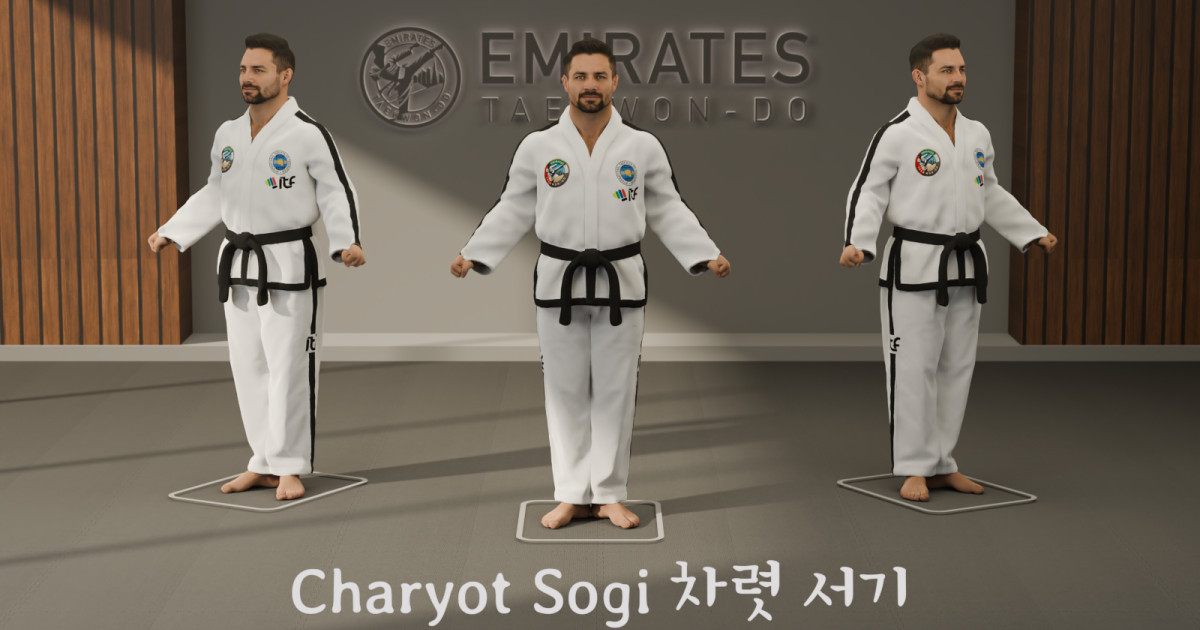

Main stance dimensions
| Reference point | Measurement |
|---|---|
| Width detail | The heels are touching |
| Weight distribution | 50% on the left leg and 50% on the right leg |
Foot and leg structure
| Body part | Technical requirement |
|---|---|
| Heels | Touching together |
| Toes | Point outward to form a 45-degree angle |
| Left leg | Fully straight and carrying 50% of the body weight |
| Right leg | Fully straight and carrying 50% of the body weight |
| Body weight | Balanced equally through both legs |
How to form the stance
Attention Stance has no width and no length. The heels are touching, so there is no measurable gap between the feet. The correct reference is that both heels remain together.
The toes point outward to form a 45-degree angle. This does not mean each foot opens carelessly or unevenly. The position should be controlled and symmetrical, with both feet forming the required angle while the heels stay connected.
Because the stance is narrow and formal, students sometimes treat it as ordinary standing. That is a mistake. Charyot Sogi is a technical position. The legs remain fully straight, the body weight is shared equally, and the body faces forward in strict full facing.
Weight distribution and posture
Attention Stance uses a 50% and 50% weight distribution. The body weight is shared equally between the left leg and the right leg. The student should not lean into one hip, rest more weight on one foot, or allow the body to drift to one side.
Both legs are fully straight. The knees should not be bent, relaxed outward, or unevenly placed. The stance should look clean, balanced, and controlled. Since the feet are together at the heels, the upper body must remain organized directly above the base.
The stance should feel upright without becoming stiff. The body remains formal and attentive, but the student should avoid unnecessary tension in the shoulders, neck, or arms. The technical standard is simple: equal weight, straight legs, heels touching, toes outward at 45 degrees, and strict full facing.
Full facing in Attention Stance
Attention Stance is performed strictly in Full Facing. The shoulders and hips are squared directly toward the front. The body should not angle into half facing, reverse half facing, or side facing.
Full facing should remain consistent with the lower-body structure. The heels stay together, the toes form a 45-degree angle, the legs remain fully straight, and the weight stays equally distributed between both legs. The body should be centered and upright.
The facing is one of the simplest checks for this stance. If the shoulders or hips turn away from the front, the stance no longer matches the required reference. Charyot Sogi should present a clear and formal full-facing position.
Reference checklist
| Check | Correct standard |
|---|---|
| Stance name | Attention Stance (Charyot Sogi) |
| Heel position | Heels touching |
| Weight | 50% left leg and 50% right leg |
| Legs | Fully straight |
| Foot angle | Toes point outward to form a 45-degree angle |
| Facing | Strictly full facing |
Common technical errors
The most common error in Attention Stance is separating the heels. Charyot Sogi has no width, and the heels should be touching. Even a small unnecessary gap changes the clean formal structure of the stance.
Another common error is making the toe angle uneven. The toes should point outward to form a 45-degree angle. If one foot opens more than the other, the stance becomes asymmetrical. If the feet are too closed or too open, the stance no longer matches the correct technical reference.
Students should also check the weight distribution. The stance uses 50% weight on the left leg and 50% on the right leg. Leaning to one side, resting on one hip, or bending one knee more than the other weakens the position. The legs should remain fully straight and equally loaded.
The final check is the facing. Attention Stance is strictly full facing. The shoulders and hips should face forward together. The stance should be formal, centered, and technically clear.
Key principle
Attention Stance is a formal zero-width stance with both heels touching, both legs straight, equal weight on both feet, and the body held strictly full facing.
Technical purpose
Attention Stance, called Charyot Sogi in Korean terminology, is one of the most basic formal positions in ITF Taekwon-Do. It is simple in appearance, but it must still be performed with accuracy. The heels touch, the legs are fully straight, the body weight is shared equally, and the toes open outward to form the required angle.
This article is a technical reference. It focuses on the specific structure of the stance: width, length, measuring point, weight distribution, leg position, foot angle, and facing. Students should use it to check the technical standard, while instructors may use it as a simple correction guide in the Dojang.