
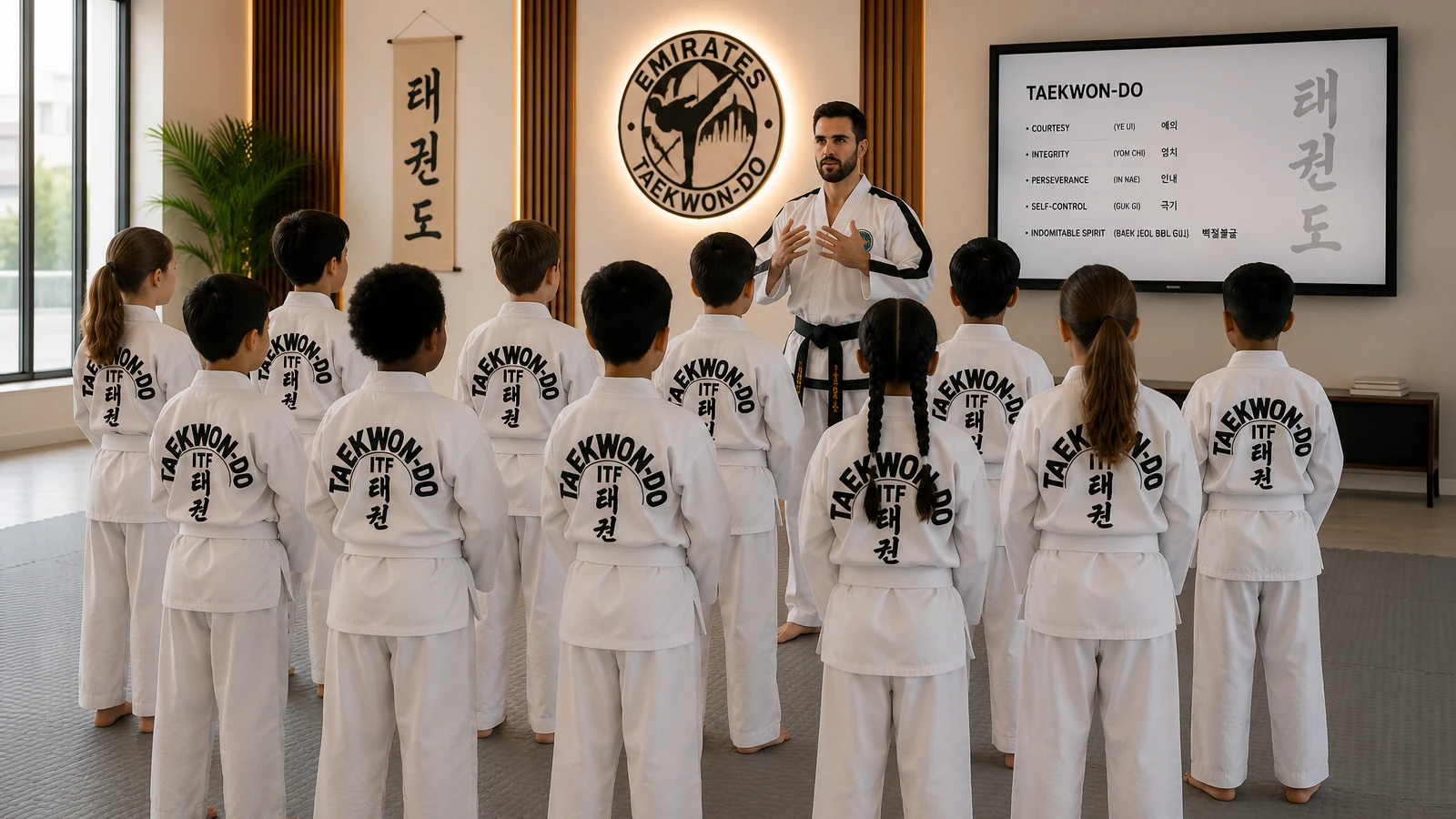
More than kicking and punching
Many people first see Taekwon-Do as a martial art focused on kicks, punches, and self-defence. While those are important parts of training, traditional ITF Taekwon-Do is much more than fighting techniques. According to General Choi Hong Hi, the Founder of Taekwon-Do, it is a complete system of physical, mental, and moral development.
Taekwon-Do was designed as a scientific method of self-defence that teaches students how to use the body efficiently while developing discipline, confidence, humility, perseverance, and self-control. Training improves coordination, balance, flexibility, fitness, reactions, focus, and emotional control. At the same time, it teaches students how to behave respectfully and responsibly both inside and outside the Dojang.
For this reason, Taekwon-Do is often described not only as a martial art, but also as a way of life.
The meaning of the word Taekwon-Do
The name Taekwon-Do comes from three Korean words:
- Tae means to kick, jump, or smash with the foot.
- Kwon means fist or hand techniques.
- Do means way, art, or path.
Taken together, Taekwon-Do means the way of the foot and fist. However, the word "Do" also carries a deeper meaning. It represents the correct way of living, self-improvement, discipline, and moral development.
This is why Taekwon-Do is not simply about learning techniques. It is about learning how to live with integrity, respect, and self-control.
A complete system of self-defence
Traditional ITF Taekwon-Do includes punches, blocks, kicks, strikes, footwork, evasions, patterns, sparring, self-defence, and breaking techniques. Students learn how to generate power efficiently using body mechanics, balance, timing, coordination, breathing, and reaction force.
One of the unique characteristics of Taekwon-Do is its highly developed kicking system. Students gradually learn front kicks, turning kicks, side kicks, reverse turning kicks, twisting kicks, flying kicks, and many other advanced techniques. The goal is not to create aggression, but to provide students with practical self-defence skills together with confidence and control.
Training is always progressive. Beginners start with basic movements and simple coordination exercises before advancing to more complex techniques and applications.
Mental and moral development
One of the most important aspects of Taekwon-Do is character development. Students are expected to apply the Tenets of Taekwon-Do in daily life:
- Courtesy
- Integrity
- Perseverance
- Self-Control
- Indomitable Spirit
These principles guide student behaviour during training, at home, at school, at work, and in society. Respect for instructors, parents, seniors, and fellow students is strongly emphasized.
Students also learn patience, emotional control, responsibility, discipline, and resilience. Through regular practice, many children and adults become more confident, focused, calm, and determined.
Benefits for children and adults
Taekwon-Do can be practiced by children, teens, adults, and seniors. Training can be adapted to different ages, goals, and physical abilities.
Children often benefit from improved confidence, focus, discipline, listening skills, coordination, social development, and physical fitness. Teenagers frequently develop resilience, leadership, responsibility, emotional control, and healthy habits.
Adults often enjoy Taekwon-Do as a complete physical and mental activity that improves fitness, flexibility, mobility, stress management, confidence, and self-defence skills.
The Encyclopedia specifically explains that Taekwon-Do is suitable for both males and females, young and old, and even people who train mainly for exercise and health.
Regular training and discipline
Taekwon-Do cannot be learned instantly. The Encyclopedia repeatedly emphasizes the importance of regular and consistent training. Through repetition, students gradually develop correct movement, coordination, timing, reflexes, power, and confidence.
Over time, movements become more natural and efficient. Students learn how to stay calm under pressure and react quickly when necessary. This process also develops perseverance and discipline.
Even students who train recreationally can enjoy significant improvements in physical condition, concentration, posture, coordination, and overall wellbeing.
The purpose of Taekwon-Do
The ultimate purpose of Taekwon-Do is not violence. The goal is to develop capable, disciplined, respectful, and confident people who can protect themselves while contributing positively to society.
General Choi Hong Hi explained that Taekwon-Do should help create a more peaceful world by developing stronger bodies, stronger minds, and stronger moral character.
True Taekwon-Do training teaches students how to avoid unnecessary conflict, control their emotions, respect others, and stand against injustice with courage and integrity.
A lifelong journey
Taekwon-Do is not something learned in a few months. It is a lifelong process of self-improvement. Every class offers an opportunity to become stronger physically, mentally, and morally.
Some students begin for fitness, some for confidence, some for discipline, and others for self-defence. Over time, many discover that Taekwon-Do becomes much more than a hobby. It becomes part of how they think, act, and live.
That is why traditional ITF Taekwon-Do continues to inspire millions of students around the world.
Based on the Encyclopedia of Taekwon-Do by General Choi Hong Hi and the ITF syllabus.
Key principle
"Taekwon-Do is a way of life." - General Choi Hong Hi
Definition according to the Encyclopedia
General Choi Hong Hi defined Taekwon-Do as "a version of unarmed combat designed for the purpose of self-defence." He explained that it is the scientific use of the body through intensive physical and mental training.
The Encyclopedia also explains that Taekwon-Do develops not only physical power and technique, but also justice, humility, fortitude, discipline, and moral character. This mental training separates a true practitioner from somebody who only wants to learn how to fight.
Taekwon-Do training therefore includes technical practice, physical conditioning, self-defence, sparring, patterns, theory, etiquette, and moral culture. Students are expected to continuously improve both their bodies and their character.