
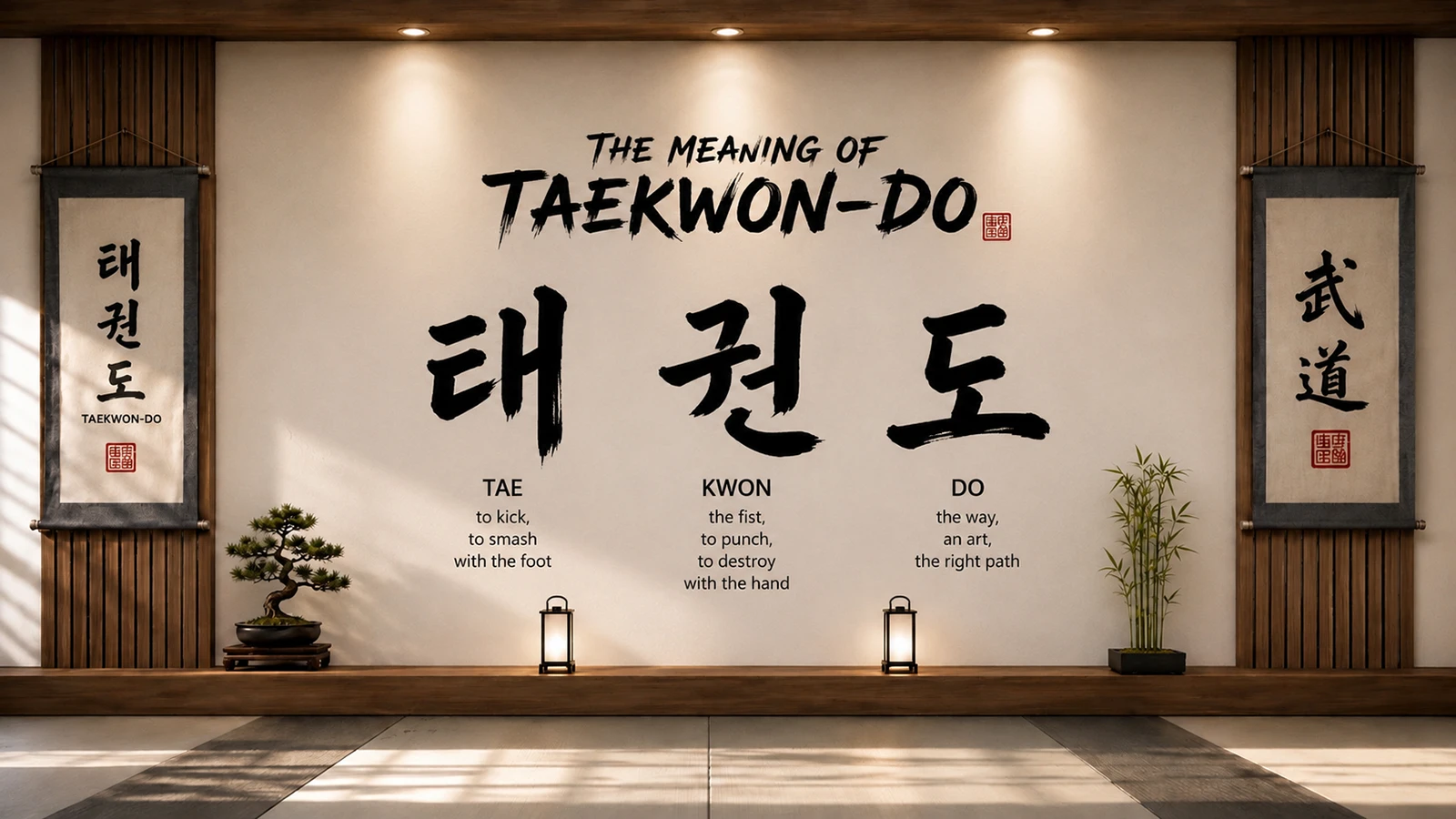
The literal meaning
The word Taekwon-Do can be understood by examining its three parts:
- Tae means to jump, fly, kick, or smash with the foot.
- Kwon means the fist or hand, especially to punch or destroy with the hand or fist.
- Do means an art, a way, or the correct path built by wise people in the past.
Taken together, Taekwon-Do indicates the mental training and techniques of unarmed combat for self-defence and health. It involves the skilled use of punches, kicks, blocks, dodges, and movement using bare hands and feet.
The word Do is especially important because it reminds students that Taekwon-Do is not only physical training. It is also a disciplined way of life that influences behaviour, thinking, and personal development.
More than self-defence
Taekwon-Do is often described as a martial art, but according to General Choi Hong Hi, it is much more than a system of punches, kicks, and self-defence techniques. Taekwon-Do represents a complete way of thinking, training, and living.
At its most basic level, Taekwon-Do is a version of unarmed combat designed for self-defence. However, its purpose goes far beyond fighting ability. Through structured physical and mental training, students develop confidence, discipline, humility, self-control, perseverance, and moral responsibility.
General Choi explained that the mental conditioning of Taekwon-Do is what separates a true practitioner from someone interested only in fighting techniques. The art is designed not only to strengthen the body, but also to strengthen character, discipline, and ethical behaviour.
The scientific use of the body
General Choi described Taekwon-Do as the scientific use of the body for self-defence. Through regular training, students learn how to use balance, timing, speed, flexibility, coordination, and power efficiently.
Taekwon-Do training uses the entire body. Muscular contraction, body movement, breathing, and timing combine to generate effective force. Students learn how to direct power toward vulnerable targets while maintaining control and balance.
Many Taekwon-Do techniques are based on speed, reaction force, and the use of an opponent momentum. Even a smaller person can create significant effect through correct timing and technique. This is one reason why Taekwon-Do allows physically weaker people to develop confidence and practical self-defence ability.
Mental discipline and character
One of the most important aspects of Taekwon-Do is mental discipline. General Choi explained that discipline, technique, and mental training help build justice, humility, courage, fortitude, and self-control.
Students are expected to develop not only technical skill, but also moral character. Through regular training, practitioners learn perseverance during difficulty, emotional control under pressure, and responsibility in their actions.
This mental development is one of the reasons Taekwon-Do is described as an art of self-defence and a way of life. The art encourages students to build strong habits, disciplined thinking, and ethical behaviour both inside and outside the Dojang.
Power and technique
Taekwon-Do is famous for its dynamic kicks, powerful strikes, aerial techniques, and breaking demonstrations. General Choi described feats such as flying over obstacles to strike a target, breaking boards with punches or kicks, and attacking multiple targets while airborne.
To beginners, these demonstrations may appear impossible. However, they are considered the result of disciplined and systematic training rather than supernatural ability. Students develop stronger conditioned reflexes through repetition, allowing movements to become natural and automatic.
General Choi emphasized that regular training is essential. Speed, power, coordination, and reaction ability are built gradually over time through consistent practice. The purpose of training is not simply to perform demonstrations, but to develop effective technique and practical self-defence ability.
The responsibility of training
Because Taekwon-Do can become a powerful method of self-defence, General Choi repeatedly stressed the importance of moral responsibility. Technical skill without self-control can become dangerous.
Students are expected to use Taekwon-Do responsibly and ethically. The purpose of training is protection, discipline, self-improvement, and justice rather than aggression or intimidation.
For this reason, Taekwon-Do training always emphasizes mental education alongside physical development. Respect, humility, courtesy, integrity, perseverance, self-control, and indomitable spirit remain central parts of the art.
Taekwon-Do for everyone
General Choi strongly believed that Taekwon-Do could benefit people of all ages and backgrounds. The art is suitable for children, teenagers, adults, and older practitioners when taught correctly.
Taekwon-Do helps improve flexibility, coordination, balance, confidence, emotional resilience, focus, fitness, and discipline. Even when practised primarily for exercise, students often discover important mental and emotional benefits.
Women, in particular, were described by General Choi as being able to benefit greatly from Taekwon-Do as a practical method of self-defence and confidence building. The principles of awareness, speed, technique, and body control allow students to defend themselves effectively regardless of physical size.
A lifelong journey
Taekwon-Do is not something fully mastered in a short period of time. It is a lifelong process of physical, technical, and personal development. Every training session helps students improve their reactions, refine their technique, strengthen their discipline, and deepen their understanding of the art.
General Choi repeatedly emphasized the importance of consistent practice. Hours spent training are never wasted because over time students develop faster reactions, stronger movements, better self-control, and greater confidence.
For this reason, Taekwon-Do is often described as more than a sport or combat system. It is a disciplined way of life that combines self-defence, health, philosophy, personal growth, and moral development into one continuous journey.
Key principle
Taekwon-Do is not only the scientific use of the body for self-defence. It is also the development of discipline, character, self-control, and moral responsibility.
FAQs on Taekwon-Do Philosophy
- What is the philosophy behind Taekwon-Do? The philosophy of Taekwon-Do emphasizes mental discipline, self-improvement, and moral responsibility alongside physical training.
- How does Taekwon-Do promote self-defence? Taekwon-Do teaches techniques for self-defence while also fostering confidence and ethical behavior in practitioners.