
Technical purpose
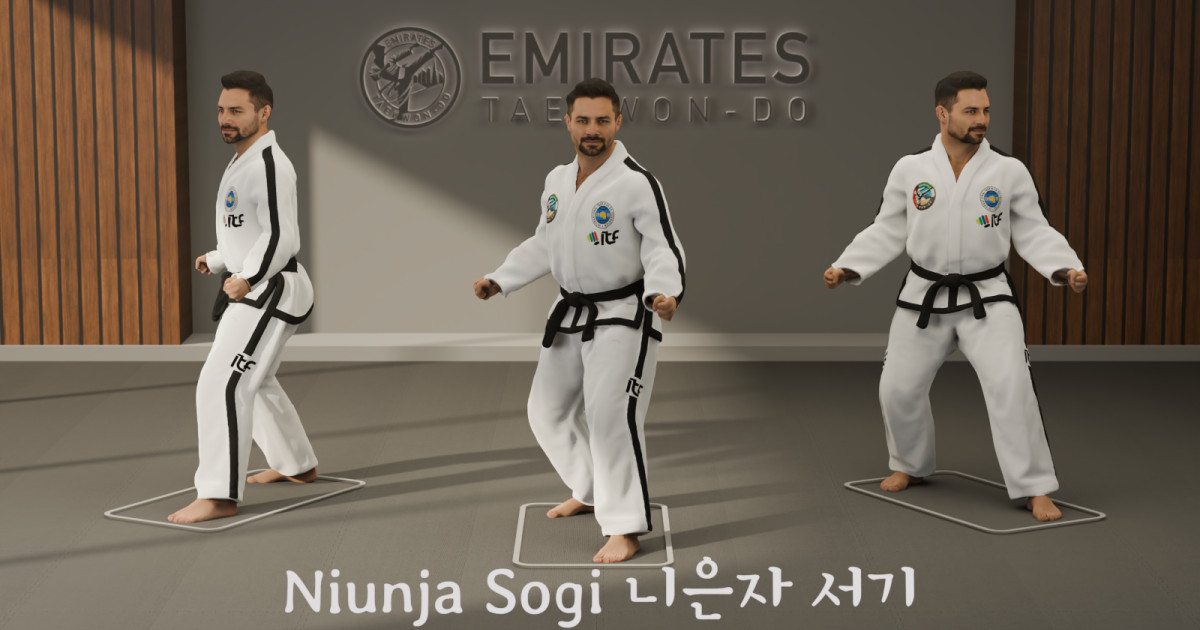
L-Stance, called Niunja Sogi in Korean terminology, is one of the most widely used defensive stances in ITF Taekwon-Do, although it is also used in attack. Its structure places most of the body weight on the rear leg, leaving the front foot relatively light and ready for kicking, shifting, or quick movement.
The stance also gives the practitioner the advantage of a half-facing body position. This reduces the target area and supports defensive movement, body shifting, and counterattack preparation.
Key principle
L-Stance is a rear-weighted, half-facing stance that protects the body while keeping the front foot ready for fast movement or kicking.
Stance structure
| Reference point | Correct standard |
|---|---|
| Stance name | L-Stance (Niunja Sogi) |
| Length | Approximately 1.5 shoulder widths |
| Length measuring point | From the footsword of the rear foot to the toes of the front foot |
| Foot relationship | The feet form almost a right angle |
| Foot angle | Toes of both feet point about 15 degrees inward |
| Stability detail | The front heel is placed about 2.5 cm beyond the heel of the rear foot |
| Weight distribution | About 70% on the rear leg and 30% on the front leg |
| Facing | Always half facing in attack and defense |
Leg and hip alignment
| Body part | Correct standard |
|---|---|
| Rear leg | Bend until the kneecap forms a vertical line with the toes |
| Front leg | Bend proportionally to support the stance without loading it too heavily |
| Hip alignment | Keep the hip aligned with the inner knee joint |
| Center of gravity | Settled mainly over the rear leg without pushing the body too far backward |
| Front foot readiness | The front foot remains readily available for kicking after a slight shift of body weight |
How to measure the stance
Move one foot to the front or rear so the distance is approximately 1.5 shoulder widths from the footsword of the rear foot to the toes of the front foot. The feet should form almost a right angle.
For better stability, the toes of both feet should point about 15 degrees inward. The front heel should be placed about 2.5 cm beyond the heel of the rear foot. If the front foot is placed too far inside, the stance becomes vulnerable to a foot sweep.
The stance should remain compact. It should not be made wider than necessary. If the stance is too wide, the front foot becomes slower to lift and the practitioner may fail to respond quickly to an attack.
Weight and facing
The weight distribution is about 70% on the rear leg and 30% on the front leg. This rear-weighted structure is what makes the front foot readily available for kicking or quick shifting.
The rear leg is bent until the kneecap forms a vertical line with the toes. The front leg bends proportionally. The practitioner should not sit excessively into the rear leg or push the bottom too far backward, because this weakens movement and can make blocking ineffective.
L-Stance is always half facing, both in attack and defense. The shoulders and hips should work with the stance so the body presents a narrower target without twisting away from the line of action.
Right and left naming rule
L-Stance is named by the bent rear leg. When the right leg is bent, it is called a right L-Stance. When the left leg is bent, it is called a left L-Stance.
This rule is important because the advanced foot does not name the stance. First identify which leg carries the greater weight and is bent as the rear leg, then name the stance as right or left.
Reference checklist
| Check | Correct standard |
|---|---|
| Length | Approximately 1.5 shoulder widths |
| Measurement | Rear footsword to front toes |
| Foot angle | Both feet point about 15 degrees inward |
| Front heel placement | About 2.5 cm beyond the rear heel |
| Rear knee | Kneecap forms a vertical line with the toes |
| Hip | Aligned with the inner knee joint |
| Weight | 70% rear leg and 30% front leg |
| Naming | Named by the bent rear leg |
| Facing | Always half facing |
Common technical errors
A common error is bending the rear leg excessively. The rear knee should form a vertical line with the toes. If the leg is overbent, the stance can become harmful and unstable.
Another error is placing the front foot too far inside. This makes the stance vulnerable to a foot sweep. The front heel should sit about 2.5 cm beyond the heel of the rear foot for better stability.
Students also commonly push the bottom too far toward the rear. This weakens the stance and can cause the block or following technique to fail. The center of gravity should be controlled, not collapsed backward.
Another frequent mistake is making the stance too wide. A stance that is too wide can prevent the defender from raising the front foot quickly enough in response to an attack.
The final error is failing to recover the original posture after jumping or shifting. L-Stance must return to its correct length, weight distribution, foot angle, and half-facing body line after movement.