A book that deserves attention
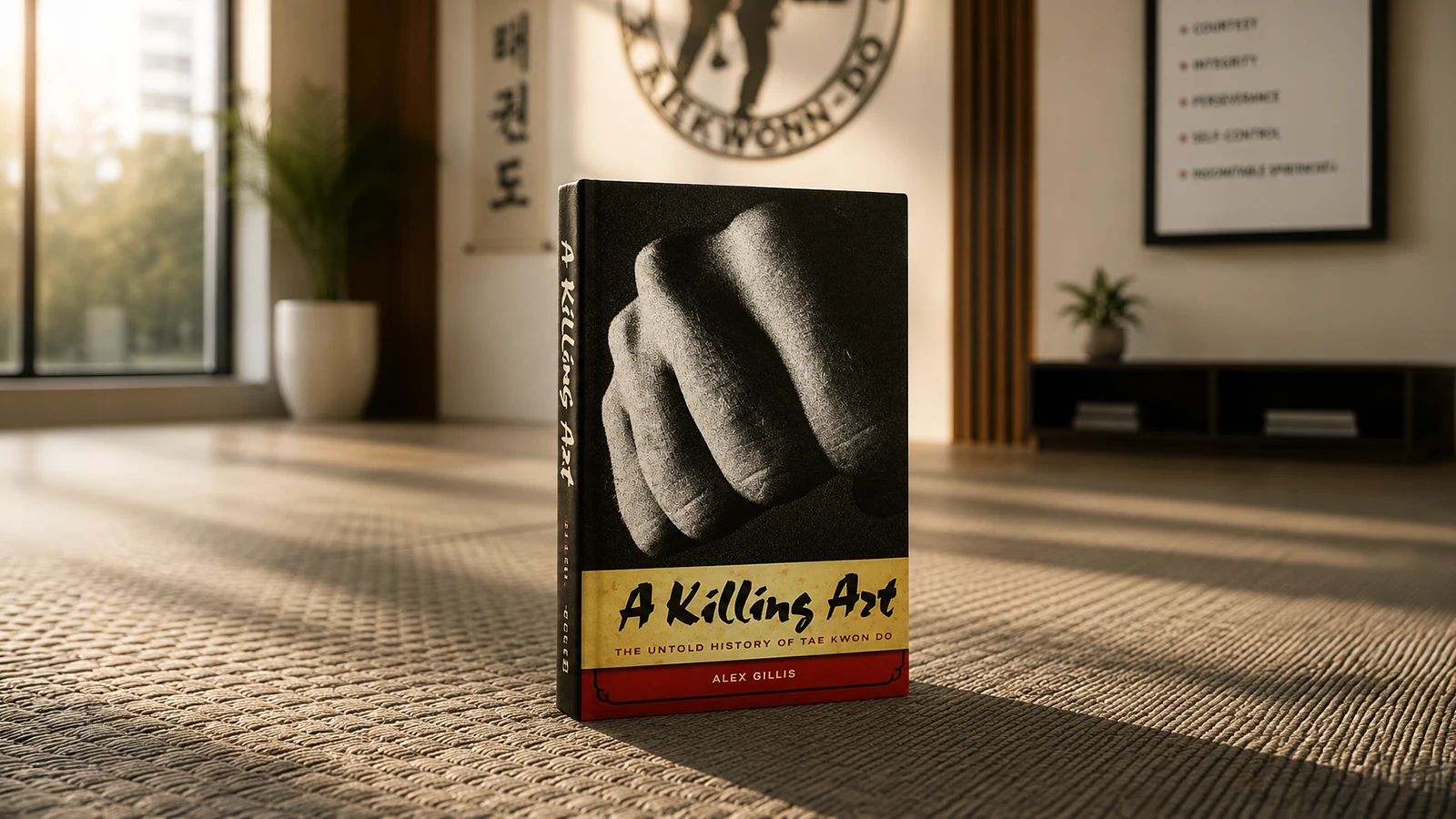
Few martial arts books generate as much discussion as A Killing Art: The Untold History of Tae Kwon Do by Alex Gillis. The book explores the political, military, cultural, and personal stories surrounding the development of modern Taekwon-Do and the figures involved in its global spread. Whether one agrees with every interpretation presented or not, there is no doubt that the amount of research, interviews, and historical investigation behind this work deserves genuine respect.
At Emirates Taekwon-Do, we believe martial artists should not fear research or difficult conversations. We practice traditional ITF Taekwon-Do according to the teachings, philosophy, terminology, and technical system developed by General Choi Hong Hi. At the same time, we also value historians, researchers, and authors who dedicate years of effort to documenting the evolution of martial arts history.
What the book covers
Alex Gillis presents a detailed narrative about the origins of modern Taekwon-Do, focusing heavily on General Choi Hong Hi, the early Korean military environment, the post-war political climate, and the divisions that eventually shaped different Taekwon-Do organizations worldwide. The book discusses the relationship between Taekwon-Do and Shotokan Karate, the role of the Korean army, the influence of politics during the Cold War, and the complex interactions between pioneers of the art.
One of the strongest aspects of the book is its human approach. Instead of portraying pioneers as mythical figures without flaws, Gillis presents them as real people living through difficult historical circumstances. The reader gains insight into the hardship of post-war Korea, military discipline, ideological conflicts, and the extraordinary determination required to spread Taekwon-Do internationally.
The author also dedicates significant attention to General Choi Hong Hi and his contribution to Taekwon-Do. Even critics of some of the book's interpretations usually acknowledge that it reinforces the undeniable importance of General Choi in the naming, systemization, technical development, and international promotion of Taekwon-Do.
A respectful approach to historical debate
At Emirates Taekwon-Do, our technical and philosophical foundation follows the Chang-Hon system and the teachings preserved within the ITF tradition. According to the Encyclopedia of Taekwon-Do by General Choi Hong Hi, modern Taekwon-Do was scientifically developed, organized, and named by General Choi himself.
The Encyclopedia also openly acknowledges the influence of Shotokan Karate and other martial systems during the developmental stages of the art. This is important because mature historical discussion should not rely on blind denial or nationalism. Martial arts evolve through exchange, adaptation, experimentation, and refinement. General Choi himself emphasized scientific development and continuous improvement throughout his life.
For this reason, we believe books like A Killing Art should not be rejected simply because they explore controversial or uncomfortable subjects. Research and historical investigation can coexist with loyalty to the ITF system and respect for the Founder.
The value of historical context
One of the greatest contributions of this book is that it reminds practitioners that Taekwon-Do did not appear in a vacuum. The art emerged during an extremely turbulent period in Korean history marked by occupation, war, poverty, ideological division, military rebuilding, and national identity struggles. Understanding this context helps students appreciate why discipline, perseverance, loyalty, and indomitable spirit became such central concepts within ITF Taekwon-Do.
The book also reinforces how difficult it was for early pioneers to spread the art internationally. Demonstration teams traveled the world with limited resources, often facing political opposition, skepticism, and personal sacrifice. Many of the conveniences modern practitioners enjoy today exist only because earlier generations endured enormous hardship.
For students and instructors alike, this historical perspective can deepen appreciation for patterns, terminology, etiquette, and the overall philosophy of Taekwon-Do beyond simply punching and kicking.
General Choi and the ITF perspective
The Encyclopedia of Taekwon-Do defines Taekwon-Do not only as a martial art but as a way of life built upon moral culture, discipline, and scientific movement. The ITF tradition places strong emphasis on the Tenets of Taekwon-Do: Courtesy, Integrity, Perseverance, Self-Control, and Indomitable Spirit.
These principles remain at the center of our teaching at Emirates Taekwon-Do. Historical research should never distract from the practical and moral purpose of training. Instead, it should enhance understanding and encourage thoughtful study.
Alex Gillis' work does not replace the Encyclopedia, the ITF syllabus, or direct technical instruction. However, it adds another layer of context for readers who wish to better understand the personalities, politics, and historical realities surrounding the development of Taekwon-Do in the twentieth century.
Why instructors should read it
For instructors especially, this book can be valuable because it encourages deeper reflection about what we teach and why we teach it. It reminds us that martial arts are not static museum pieces. They are living systems carried by people, shaped by society, and influenced by history.
Good instructors should not fear informed discussion. In fact, the strongest instructors are often those who study broadly while remaining grounded in their own technical lineage and principles.
Reading books like A Killing Art can also help instructors answer difficult student questions with maturity and balance rather than defensiveness. A serious martial artist should be capable of respectful historical discussion without losing respect for the Founder, the art, or the traditions being practiced.
The Author

Final thoughts
At Emirates Taekwon-Do, we sincerely appreciate the effort Alex Gillis invested into documenting this complex part of martial arts history. Researching interviews, collecting historical accounts, studying political context, and writing such a detailed work requires enormous dedication.
Even if some interpretations may continue to be debated among practitioners, the book unquestionably contributes valuable discussion and historical perspective to the Taekwon-Do community.
We continue to practice traditional ITF Taekwon-Do according to the teachings of General Choi Hong Hi and the Chang-Hon system. At the same time, we encourage serious students and instructors to remain intellectually curious, respectful, and open to learning more about the fascinating history behind the art we love.
Understanding Taekwon-Do history does not weaken tradition. When approached with integrity and respect, it strengthens appreciation for the journey, sacrifice, and vision that shaped modern Taekwon-Do into the global martial art it is today.
A martial art without history becomes only exercise. Understanding the struggles, sacrifices, and personalities behind Taekwon-Do gives deeper meaning to training.