
Purpose of the rank system
The Emirates Taekwon-Do rank system was designed to help students progress through Traditional ITF Taekwon-Do in a structured, safe, and age-appropriate way. While the official ITF syllabus remains the technical foundation of the program, our academy organizes the progression differently according to the student's age, physical development, maturity, and learning ability.
The purpose of the rank system is not simply to award belts. Each stage was created to develop confidence, discipline, leadership, teamwork, coordination, technical understanding, and respect for others. Students progressively build physical and mental skills while learning the principles and philosophy of Traditional ITF Taekwon-Do.
As students mature, the syllabus gradually becomes more technical and demanding. Younger children focus heavily on physical discovery and basic movement development, while older students begin following the complete Traditional ITF ranking structure and technical expectations.
The system also helps students maintain motivation by dividing large goals into smaller and more achievable stages while preserving the standards and spirit of Taekwon-Do.

Ranks for ages three to six
For children between the ages of 3 and 6, Emirates Taekwon-Do uses a special "Lines System." These ranks are designed specifically for very young children and serve as intermediate stages between the Traditional ITF White Belt (X Gup) and White-Yellow Belt (IX Gup).
All ranks in this stage use a white belt with different colored transversal lines:
- White I - White Belt Child
- White II - White Belt Yellow Line
- White III - White Belt Orange Line
- White IV - White Belt Green Line
- White V - White Belt Blue Line
- White VI - White Belt Purple Line
- White VII - White Belt Red Line
The objective of this system is to divide the beginner syllabus into smaller, realistic, and age-appropriate goals. At this age, students are still discovering balance, body coordination, reaction, discipline, and social interaction. The system allows them to experience regular achievement while progressing safely and confidently.
These stages also create a positive first experience inside the Dojang while introducing children to the structure and culture of Traditional ITF Taekwon-Do.

Confidence system for early childhood development
Early childhood development focus
During the Lines System, the emphasis is placed much more on physical discovery, coordination, confidence, teamwork, and leadership than on memorizing large amounts of technical material. Children at this age develop best through repetition, encouragement, routine, and positive reinforcement.
Students begin learning the foundations of Taekwon-Do through simple but essential movements. These include the three basic kicks:
- Front Snapping Kick
- Turning Kick
- Side Piercing Kick
They also begin learning fundamental stances and hand techniques such as Parallel Stance (Narani Sogi), Walking Stance (Gunnun Sogi), Attention Stance (Charyot Sogi), Middle Punch (Kaunde Jirugi), Low Outer Forearm Block (Najunde Palmok Makgi), Low Knife-Hand Block (Najunde Sonkal Makgi), and Middle Inner Forearm Block (Kaunde An Palmok Makgi).
Equally important, children are introduced to the Tenets of Taekwon-Do:
- Courtesy
- Integrity
- Perseverance
- Self-Control
- Indomitable Spirit
These values are constantly reinforced through teamwork exercises, leadership activities, discipline drills, partner work, and respectful behavior inside the Dojang.
Sparring progression for children
Safety is extremely important in the Emirates Taekwon-Do program, especially for young students. For this reason, sparring progression is introduced gradually according to age, control, maturity, and technical level.
During the early stages of the Lines System, students practice movement drills, reaction exercises, distance control, and non-contact sparring. The objective is not competition or aggression, but rather developing awareness, confidence, balance, reaction speed, and coordination while learning how to work respectfully with partners.
As students advance through the later stages of the program, they begin learning how to use protective equipment correctly. This includes hand protection, foot protection, and head protection.
Only after demonstrating sufficient control, discipline, and technical understanding are students introduced to light-contact sparring exercises. Even at this stage, control, safety, and respect remain the highest priorities.
This progressive system allows students to gain confidence gradually while avoiding fear, excessive pressure, or unnecessary injuries during their early years of training.
Ranks for ages seven to eleven
For students between the ages of 7 and 11, Emirates Taekwon-Do introduces a restricted version of the Traditional ITF syllabus. The objective is to progressively transition students into the official ranking structure while still adapting the learning process to their age and development.
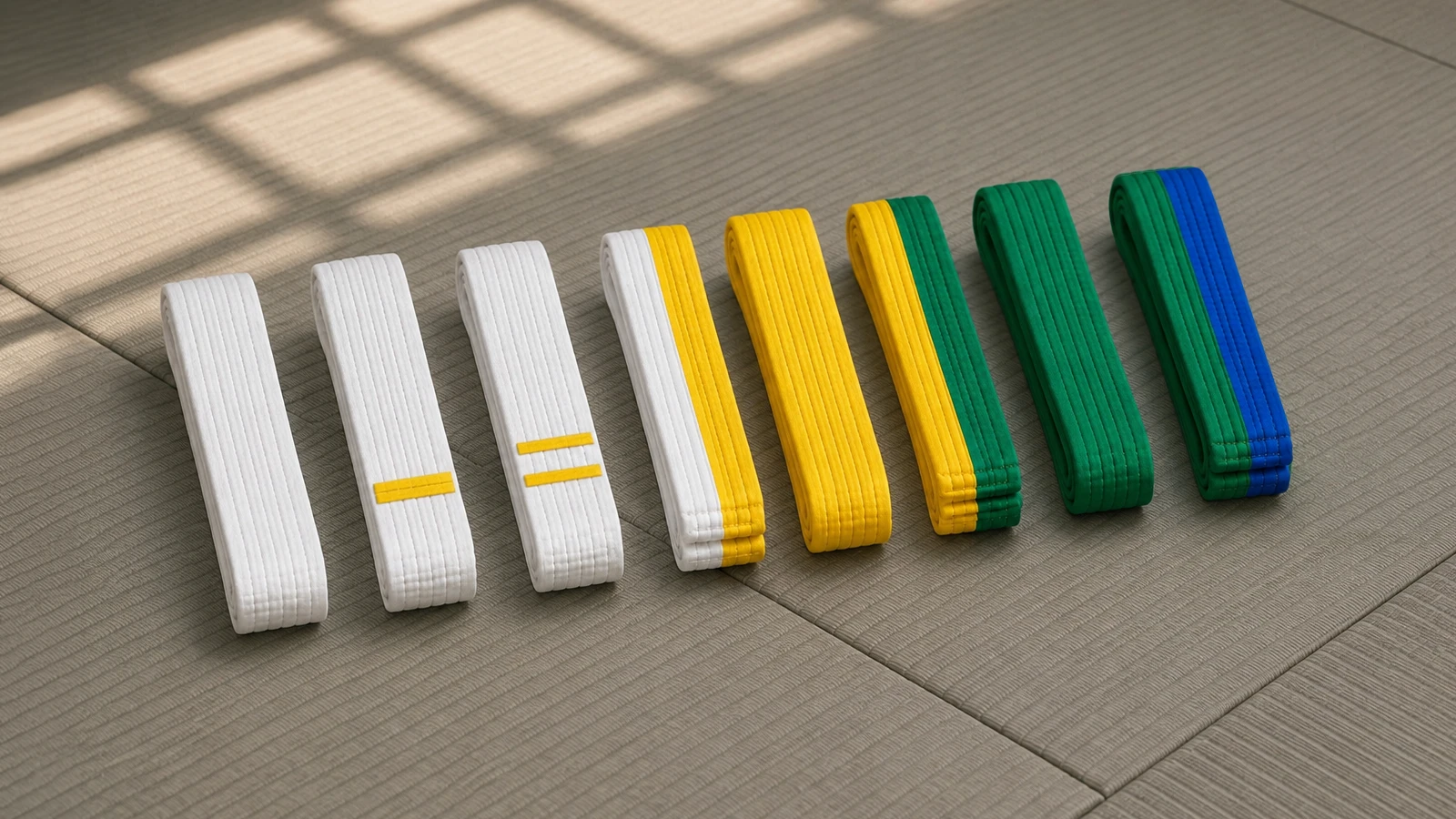
At this level, the traditional White Belt syllabus is divided into three separate examinations:
- First Stripe
- Second Stripe
- White-Yellow Belt (IX Gup)
The First Stripe and Second Stripe stages were specifically created to divide the large amount of White Belt material into smaller and more achievable steps. This allows students to spend more time building strong foundations before advancing to more technical material.
After White-Yellow Belt, students continue progressing through:
- Yellow Belt (VIII Gup)
- Yellow-Green Belt (VII Gup)
- Green Belt (VI Gup)
- Green-Blue Belt (V Gup)
At Emirates Taekwon-Do, Green-Blue Belt is the maximum achievable rank for students under 12 years old.
Traditional ITF progression
Beginning at the age of 12, students officially enter the complete Traditional ITF syllabus and ranking system followed at Emirates Taekwon-Do.
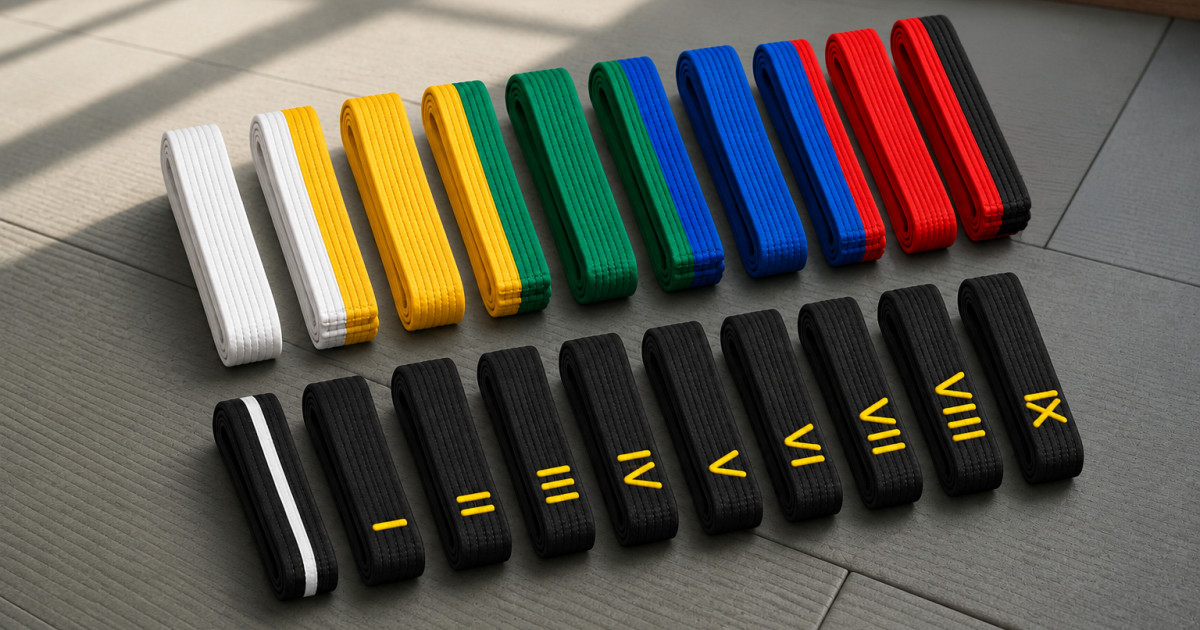
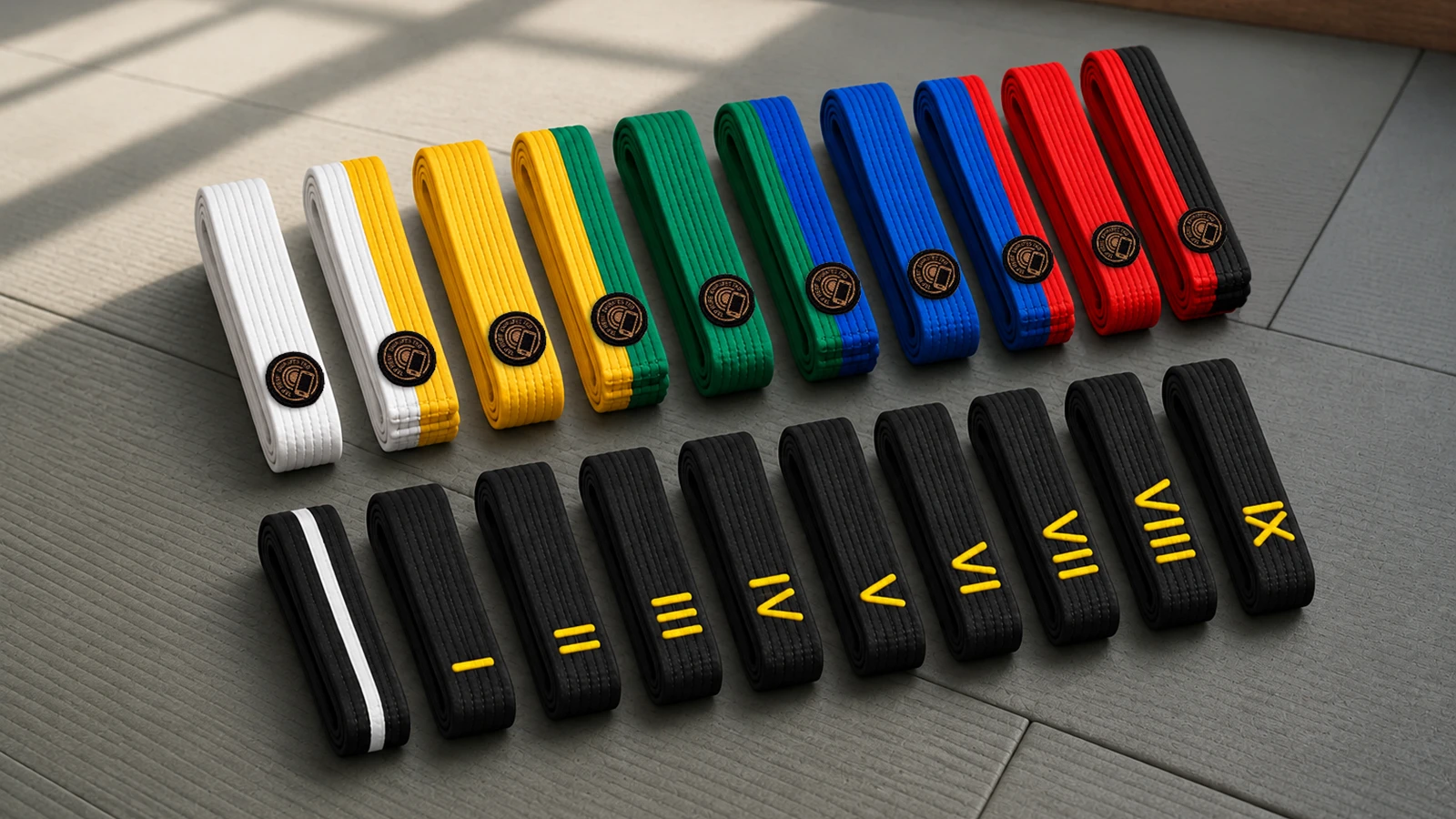
The progression follows the standard Chang-Hon structure:
- White Belt (X Gup)
- White-Yellow Belt (IX Gup)
- Yellow Belt (VIII Gup)
- Yellow-Green Belt (VII Gup)
- Green Belt (VI Gup)
- Green-Blue Belt (V Gup)
- Blue Belt (IV Gup)
- Blue-Red Belt (III Gup)
- Red Belt (II Gup)
- Red-Black Belt (I Gup)
Students must meet both technical and maturity requirements before promotion. Emirates Taekwon-Do applies strict minimum age requirements for advanced belts. Blue Belt requires a minimum age of 12 years old, Red Belt requires a minimum age of 14 years old, and Black Belt requires a minimum age of 16 years old.
At these stages, students study the complete Traditional ITF syllabus including Tul, sparring, self-defence, theory, terminology, discipline, and advanced technical development.
Black belt and DAN structure
After successfully completing the Red-Black Belt stage, students may test for Black Belt according to the Emirates Taekwon-Do and Traditional ITF requirements.
Students between 16 and 18 years old receive the rank of Junior Black Belt. This belt includes a white transversal line identifying the student as a junior black belt holder.
Students 18 years old and above receive the official I DAN Black Belt rank.
The black belt progression continues as follows:
- Black Belt I DAN
- Black Belt II DAN
- Black Belt III DAN
- Black Belt IV DAN
- Black Belt V DAN
- Black Belt VI DAN
- Black Belt VII DAN
- Black Belt VIII DAN
- Black Belt IX DAN
Titles also evolve according to rank and age:
- I DAN to III DAN - Bo Sa Bum or Sa Bum
- IV DAN to VI DAN - Sa Bum Nim
- VII DAN to VIII DAN - Sa Hyun Nim
- IX DAN - Grand Master or Sa Seong Nim
In Korean martial arts terminology, “Nim” (님) is an honorific suffix. It conveys respect, similar to “sir,” “master,” or “honored person,” depending on context.
So in Taekwon-Do terminology:
* “Sabum” (사범 / 師範) refers to an instructor or teacher.
* “Sabum Nim” (사범님) means “respected instructor”.
At Emirates Taekwon-Do, black belt represents leadership, technical mastery, discipline, responsibility, and continued lifelong learning.

Transition belts system
Emirates Taekwon-Do also uses an internal Transition Belt system for students transferring from other schools or other lines of Taekwon-Do.
These belts include a transversal white line across the original belt color and are used temporarily while the student adapts to the Emirates Taekwon-Do syllabus, standards, terminology, technical requirements, and grading structure.
The purpose of the system is to respectfully recognize the student's previous effort while still maintaining the technical integrity and standards of the academy.
Transition belts currently exist for Yellow, Green, Blue, and Red levels. During this adaptation stage, students work on recovering missing technical material, improving foundations, and learning the specific requirements of our Traditional ITF system.
Once the student successfully demonstrates the required level and passes the appropriate examination, the transition belt is replaced with the official Emirates Taekwon-Do rank.
This system helps maintain honesty, transparency, technical quality, and respect for every student's martial arts journey.